Skip to content

TIBHIRT N LQADI, TINQ

The Judge’s Garden, Yours.
Cactus ficus-indica: a plant that came from the Americas. We made it ours.
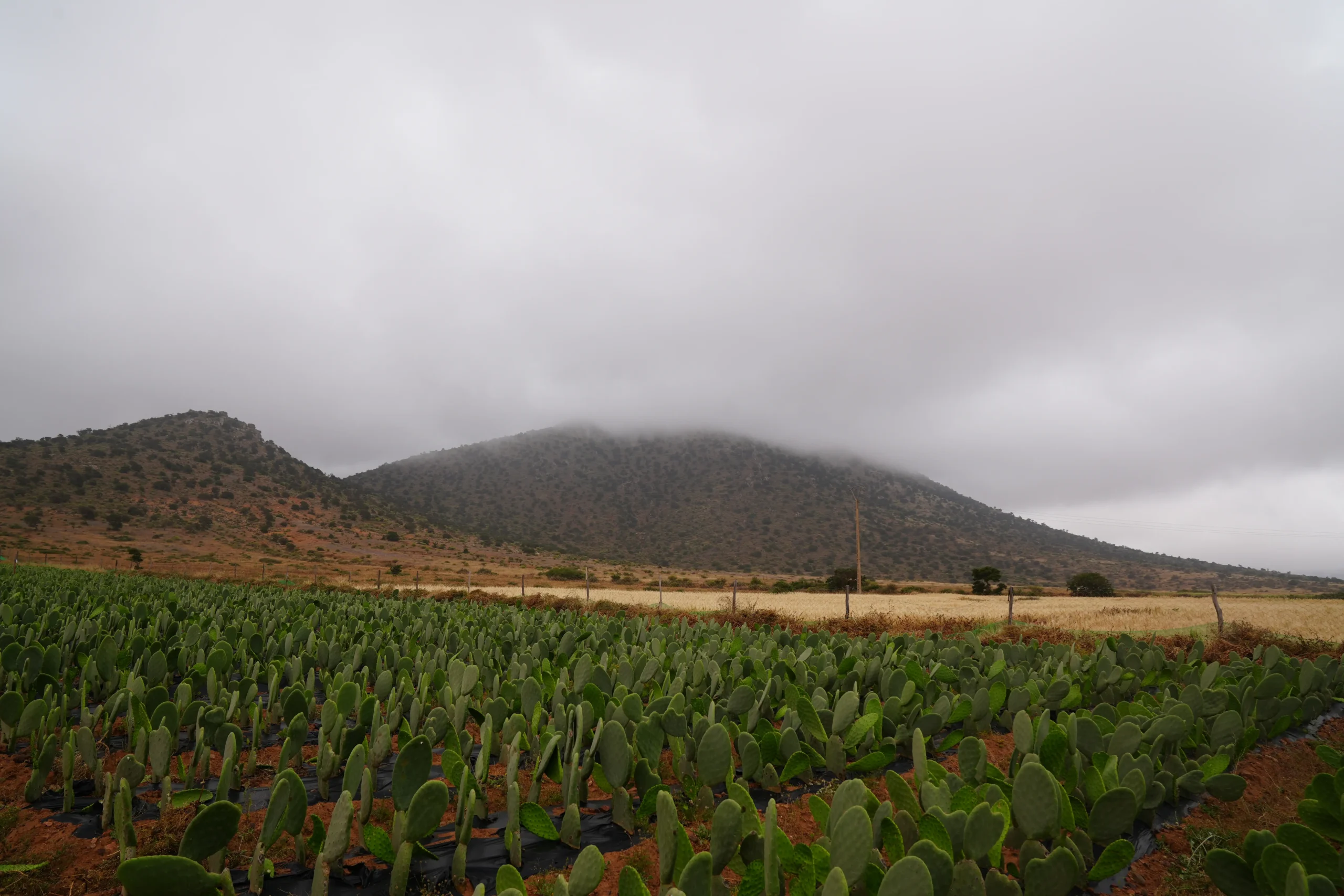
In Aït Baâmrane, Cactus ficus-indica, locally called Aknari, became far more than a cactus. It became food, fodder, income and an increasingly important economic resource, supporting farmers and cooperatives across the region. Its importance grew so much that it was beginning to compete with argan as a source of rural livelihood. Then an invasive cochineal broke the system. What disappeared was not simply a plant, but an economy built around it.

The Plant

It came from the Americas. Over centuries, it became ours.
Cactus ficus-indica travelled from Mexico and Central America across the Atlantic and eventually found a home in the Anti-Atlas after passing through the Canary Islands. Here, it became Aknari. A plant adapted to heat and scarcity became part of how people fed themselves, raised animals, earned a living and cared for the land.

The Golden Years

When Aknari became an economy
Once established in Aït Baâmrane, Cactus ficus-indica found an extraordinary fit with the landscape.\n\nIt could withstand heat and scarcity while providing what the region needed: food, fodder and income. And when times were hardest, Aknari could mean something even more fundamental: food when other crops failed. During periods of famine, it helped people survive.\n\nOver generations, farmers developed ways of cultivating it, local varieties were maintained, and cooperatives grew around its production and transformation.\n\nAknari became woven into everyday life and the rural economy. Its importance grew steadily, to the point where it was beginning to rival argan as a source of livelihood, especially when a new discovery was made: even the tiny seeds inside the fruit held value.\n\nPressed into oil, they produced a precious facial oil, opening yet another possibility for the cactus and for the people who cultivated it.\n\nFruit, cladodes, seeds — almost nothing was without value.\n\nAknari was becoming more than a crop.\n\nIt was becoming an economy.

The Invasion

When the balance broke
Then came the cochineal.

In 2014, Dactylopius opuntiae was detected in Morocco. By 2018, it had reached Aït Baâmrane. What followed was not simply an agricultural pest outbreak, but an ecological crisis that swept through one of the region’s most important plants.

The insect spread rapidly across cactus plantations, feeding on the plant until entire fields were left charred.

And because Aknari had become so deeply woven into life here, its disappearance rippled outward.

Fields that had once provided food and fodder were emptied. Farmers lost a source of income. Biodiversity was diminished. A landscape that had depended on the cactus for generations suddenly lost one of its most resilient elements.

The scale was enormous: more than 280,000 hectares of cactus were affected across southwest Morocco alone, according to local statistics.

But the numbers only tell part of the story.

Aknari had survived drought, scarcity and generations of change.

It was an invasive species that finally brought it to its knees.

The Loss

When the landscape went silent
After the cochineal passed through, the landscape was almost unrecognizable.

Fields of Aknari that had once been dense and green stood stripped and blackened, as if they had been through a fire.

But this was not only the loss of a crop.

It was the loss of a landscape and the life within it.

Aknari had provided food and fodder, income and security. Its disappearance weakened households already facing drought, poverty and migration. But the cactus was also part of a wider living system: it protected soil, provided shelter and food for other species, and contributed to the biodiversity of the landscape.

When the cactus disappeared, many of those relationships disappeared with it.

The desolation was physical, but it was also emotional.

Communities watched familiar fields become empty. A plant that had helped people through difficult years was suddenly gone. There was little to replace it, and little sense of what could come next.

But what happened in Aït Baâmrane was not an isolated story.

Across the planet, ecosystems are being pushed out of balance by a combination of climate change, biodiversity loss, habitat degradation and the movement of species beyond the ecological relationships that once kept them in check.

The cochineal was one invasion. The deeper story is a planet increasingly out of balance.

Here, that global crisis was made visible in one landscape.

And perhaps that is what made the loss so profound:

The Dilemma

How do you save a landscape without harming it?
When the cochineal spread, the urgency was enormous. The cactus was disappearing, and farmers needed a response.

Chemical treatment was proposed as one way to fight the invasion.

But killing the cochineal was not the only consideration.

What would happen to everything else?

Broad chemical treatments could affect non-target insects, including pollinators and natural enemies, as well as soil organisms and the wider biodiversity of the landscape. The concern was not simply whether the treatment could kill the pest, but whether, in saving the cactus, we might damage the living system around it.

That created a difficult choice:

Do we fight the invasion with whatever means are available, or do we look for a way to restore the ecological balance that has been disrupted?

For Dar Si Hmad, this became the beginning of a different path.

Not chemical warfare against an insect.

But biological control within a living ecosystem.

Chemical treatment

Biological control

Perhaps the question was never:
How do we destroy the cochineal?
Perhaps it was:
How do we restore a balance in which the cactus can live?
That shift — from fighting an enemy to rebuilding a relationship — opened the way to our next discovery.

And somewhere in that search, we found Lalla Messaouda.

Going Back to Mexico

Learning from where Aknari came from

When the cochineal devastated Aknari in Aït Baâmrane, we could have looked only for a way to eliminate it.

Instead, we looked back to where the cactus came from.

Mexico.

There, Indigenous communities have lived with Cactus ficus-indica and the cochineal for generations. Their knowledge holds a different understanding of the plant: not as an isolated crop, but as part of a living relationship between plants, insects, soil, climate and people.

So Dar Si Hmad went to Mexico to listen and learn.

We encountered Indigenous knowledge built through generations of observation and experience — knowledge of the cactus, its cultivation, its pests and the natural relationships that help keep them in balance.

What we brought back was not simply a technique.

We brought back another way of thinking about the problem.

Lalla Messouda

The one who brings luck
Our search in Mexico led us to a small but powerful ally: Hyperaspis trifurcata, a natural predator of the cactus cochineal.

We nicknamed her Lalla Messaouda — Messaouda, the one who brings good fortune. The name came from what she represented to us: after the devastation of the cochineal, here was a small living ally that could help restore the balance.

But finding an ally is only the beginning.

To make biological control possible in Aït Baâmrane, we needed a place to protect, multiply and learn — both the cactus and the predator.

That place is Tibhirt N Lqadi, TINQ — the Judge’s Garden, and where recovery begins.

Today, around 14,000 mother plants grow there, preserving the Aknari varieties (Moussa and Aissa) from which new plants can return to the landscape. And now, a new production unit is being developed to multiply Lalla Messaouda, so that her protection can eventually travel with the cactus.
TINQ is becoming a place where two lives meet:
the plant we are trying to bring back, and the ally that can help it survive.

From here, both can begin their journey back to the farmers.

The Return

From mother plants back to the landscape
Recovery cannot stop at TINQ.

A garden can preserve what remains. But for Aknari to return, the plants have to leave the garden and find their way back into the landscape.

That is what is happening now.

From our mother plants, we have propagated Aknari and shared plants with more than 30 farmers, who are growing them according to our cultivation protocol.

Local varieties can return to fields. Farmers can begin rebuilding what was lost. And each new plantation becomes another place where Aknari can take root again.

But we have learned that bringing back the plant is only half of the work.

The cochineal is still there.

So we are preparing the next step: making Lalla Messaouda available too — so that farmers do not simply receive the cactus, but also have access to its natural ally when the cochineal returns.
Plants can travel.
Predators can travel.
Knowledge can travel.

What began in TINQ is beginning to move back through the landscape.

And with every farmer who plants again, Aknari becomes a little less a memory and a little more a future.

The Possibility

Can we restore what was lost?
The return of Aknari is not simply about planting cactus again.

It is about rebuilding a web of relationships:
We cannot undo the invasion. We cannot simply recreate the landscape that existed before it.

But we can experiment with what comes next.

At Tibhirt N Lqadi, Aknari is being multiplied. With farmers, it is returning to the land. With Lalla Messaouda, we are learning to protect it without poisoning the ecosystem around it.

This is not a finished model. It is a path being tested.

And perhaps this is one of the roles of civil society: to create a space between what is already known and what has not yet been tried. A place where communities, researchers, practitioners and partners can come together to test another way.

Not waiting for a perfect solution.
Not pretending to have all the answers.
Making another possibility tangible.

This experiment is still unfolding.
We invite farmers, researchers, partners and fellow citizens to learn from it, contribute to it and help us explore what else might be possible.

Because restoring a landscape is not the work of one organization. It is something we learn to do together.

BUILDING THE FUTURE TOGETHER

Our work is built through relationships — with the people who live in the territories where we work, with researchers and universities, with technical partners, institutions, funders and others who bring knowledge, resources and perspectives that we do not have ourselves.
Meet our Partners & Collaborators